
ATTENTION:

Showing posts with label Space Exploration. Show all posts
Showing posts with label Space Exploration. Show all posts
Friday, February 01, 2013
The Columbia Seven - Ten Years
At approximately 8:59:32AM EST on February 1, 2003 - 15 days, 22:20:32 into her mission - Space Shuttle Columbia (OV-102) was destroyed on reentry due to catastrophic damage suffered during the launch of STS-107 sixteen days before on January 16. All seven members of her crew perished.


Sunday, August 26, 2012
Neil Alden Armstrong, 1930-2012
Not breaking news at this point, but I'm sure you've heard that we lost Neil A. Armstrong, the first man to walk on the Moon, to complications following surgery for coronary artery disease. He was just a few weeks past his 82nd birthday.
I have two Apollo-era photographs as part of my "Finest Hour" sidebars. One (right side, below the House campaign links) shows Apollo 11, the flight Armstrong commanded, punching through the sound barrier with a visible puff of mist during launch on July 16, 1969 - the massive Saturn V rocket framed quite nicely with our flag.
The second is an iconic photograph of astronaut Jack Schmitt on the moon, with both the flag and the Earth in the frame, taken nearly 40 years ago in December, 1972. You'd think a "finest hour" would be a picture of Neil Armstrong on the Moon, no?
Well, except for still frames from the motion picture camera mounted inside the lunar module Eagle, or the grainy TV image stills, there are no pictures of Armstrong on the Moon, unlike the well known photo of Buzz Aldrin. The astronauts only had one EVA camera, and he never gave it to Aldrin to take his picture.
But, that was the kind of person Neil Armstrong was. He never sought to exploit his unique position as the "First Man", and for me, that just adds to his stature.
Apollo 11's Command Module Pilot, Michael Collins, said simply: "He was the best, and I will miss him terribly."
When my wife and I were approaching the birth of our son in 2005, there was only one boy's name we really liked, and that was "Neil". Space program fans both of us, we're proud to have named our son for Mr. Armstrong.
Twelve men walked on the Moon. We've lost four of them (James Irwin, Alan Shepard, Charles "Pete" Conrad, and now Neil Armstrong). Eight are still with us: Buzz Aldrin, Alan Bean, Ed Mitchell, Dave Scott, John Young, Charlie Duke, Gene Cernan, and Jack Schmitt (yes, I rattled them off from memory). If you ever need a lesson in what "American Exceptionalism" truly means, those twelve names (eighteen, actually - don't forget the six CMPs who went with them: Collins, Gordon, Roosa, Worden, Mattingly, and Evans) are a great place to start.
As I posted to Facebook and Twitter last night, "Rest in Peace, First Man".
Friday, January 27, 2012

Wednesday, May 13, 2009
Congratulations Atlantis!
 (Image: NASA)
The crew of Space Shuttle Atlantis has successfully rendezvoused with, captured, and berthed the Hubble Space Telescope! The first of five space walks to service the observatory takes place tomorrow.
Great job to all!
Monday, May 11, 2009
Godspeed STS-125!
 Image: NASA
Space Shuttle Atlantis, carrying a crew of seven, has succesfully attained orbit after launch this afternoon from Kennedy Space Center! Commander Scott Altman and his six crewmates are in pursuit of the Hubble Space Telescope for its fifth and final on-orbit service.
Wednesday, December 03, 2008
TFH 12/4: First to Jupiter!
Thirty-five years ago today, NASA's Pioneer 10 became the first spacecraft to fly by Jupiter and photograph the planet up close! Pioneer 10 and its brother Pioneer 11 paved the way for the follow-on explorations of the outer solar system by Voyager 1, Voyager 2, Galileo, Cassini, and New Horizons.
December 3, 1973 was a finest hour for NASA and our great, space-faring Nation!
More information:
NASA
Encyclopedia Astronautica
Wikipedia
December 3, 1973 was a finest hour for NASA and our great, space-faring Nation!
More information:
NASA
Encyclopedia Astronautica
Wikipedia
Wednesday, March 26, 2008
Welcome Home Endeavour!
 Space Shuttle Endeavour has just landed at the Kennedy Space Center after 16 days in orbit building the International Space Station on mission STS-123. Congratulations and Welcome Home to:
Dominic Gorie (Commander)
Gregory H. Johnson (Pilot)
Robert L. Behnken (MS1)
Michael Foreman (MS2)
Richard M. Linnehan (MS3)
Takao Doi (MS4, Japan JAXA)
An extra special welcome home goes out to Leopold Eyharts of the European Space Agency who is returning to Earth after about a month and a half onboard the ISS. NASA Astronaut Garrett E. Reisman launched with Endeavour and assumed Eyhart's position onboard the space station.
Five spacewalks, assembly of the Dextre robot, delivery of the first portion of the JAXA pressurized modules for the ISS; no doubt, a finest hour in space exploration!!!!
Monday, March 17, 2008
TFH 3/17: Vanguard 1 - 50 Years in Orbit!
On March 17, 1958 the United States Naval Research Laboratory succesfully launched Vanguard 1 into orbit. Vanguard 1 was the first solar powered satellite, the second satellite launched successfully by the free world, and the fourth orbiting man-made satellite overall.
Today 50 years on, though its transmitters are long silent, Vanguard 1 continues to orbit the Earth as the oldest man-made object in space.
Read more at the Naval Research Laboratory's Tribute Site.
50 years - ~196,000 orbits - by any count, a finest hour in space exploration!
Today 50 years on, though its transmitters are long silent, Vanguard 1 continues to orbit the Earth as the oldest man-made object in space.
Read more at the Naval Research Laboratory's Tribute Site.
50 years - ~196,000 orbits - by any count, a finest hour in space exploration!
Tuesday, February 20, 2007
TFH 2/20: John H. Glenn, Jr.
 Before February 20, 1962 the United States was lagging in the space race and attaining President Kennedy's goal of reaching the Moon. Our Cold War, Communist enemies in the Soviet Union had racked up success after success (well, they didn't publicize their failures) and NASA had yet to put a human in orbit. On that morning, the hopes of the free exploration of space rested with an Atlas booster perched on the pad at Cape Canaveral's Launch Complex 14 with Mercury Spacecraft #13 mounted at the top. Into this titanium, cone-shaped spacecraft - not quite seven feet tall and just over six feet in diameter - climbed John H. Glenn, Jr. Glenn had named his spacecraft "Friendship 7"
His path to orbit was far from certain. To that point (by my count looking at Encyclopedia Astronautica) in a minimum of 79 times that either NASA or the USAF attempted to launch an Atlas missile, 33 times the launch ended in failure. That's a 58.2% success rate; hardly the confidence one would want to ride into space with!
At 9:47:35 EST, the Atlas roared to life and four seconds later Glenn, and the hopes of a nation, were airborne. Just five thrilling minutes later, and the first free man was safely in orbit!
Three times around our Earth later, Glenn prepared his spacecraft for reentry. Mission controllers had detected a problem that could lead to a disaster. Instrumentation reported that the spacecraft's heat shield may have come loose; without its protection, Glenn and his spacecraft would be incinerated.
The heat shield held (the instrumentation was later found to be in error), and Glenn splashed down safely in the Atlantic Ocean at 14:43:02. The official NASA history of his flight is found here. Throughout the rest of the Mercury program, in many ways the United States still trailed the Soviets. Glenn's successful flight put us solidly on the road to the moon, and there was no looking back.
John H. Glenn, Jr.: February 20, 1962 - forty-five years ago today - was your finest hour!
Thursday, February 01, 2007
In memoriam: 2/1/2007
 Michael P. Anderson - David M. Brown - Kalpana Chawla - Laurel B. Clark
Rick D. Husband - William C. McCool - Ilan Ramon
STS-107 (Columbia) - Lost on Reentry
Sunday, January 28, 2007
In Memoriam: 1/28/2007
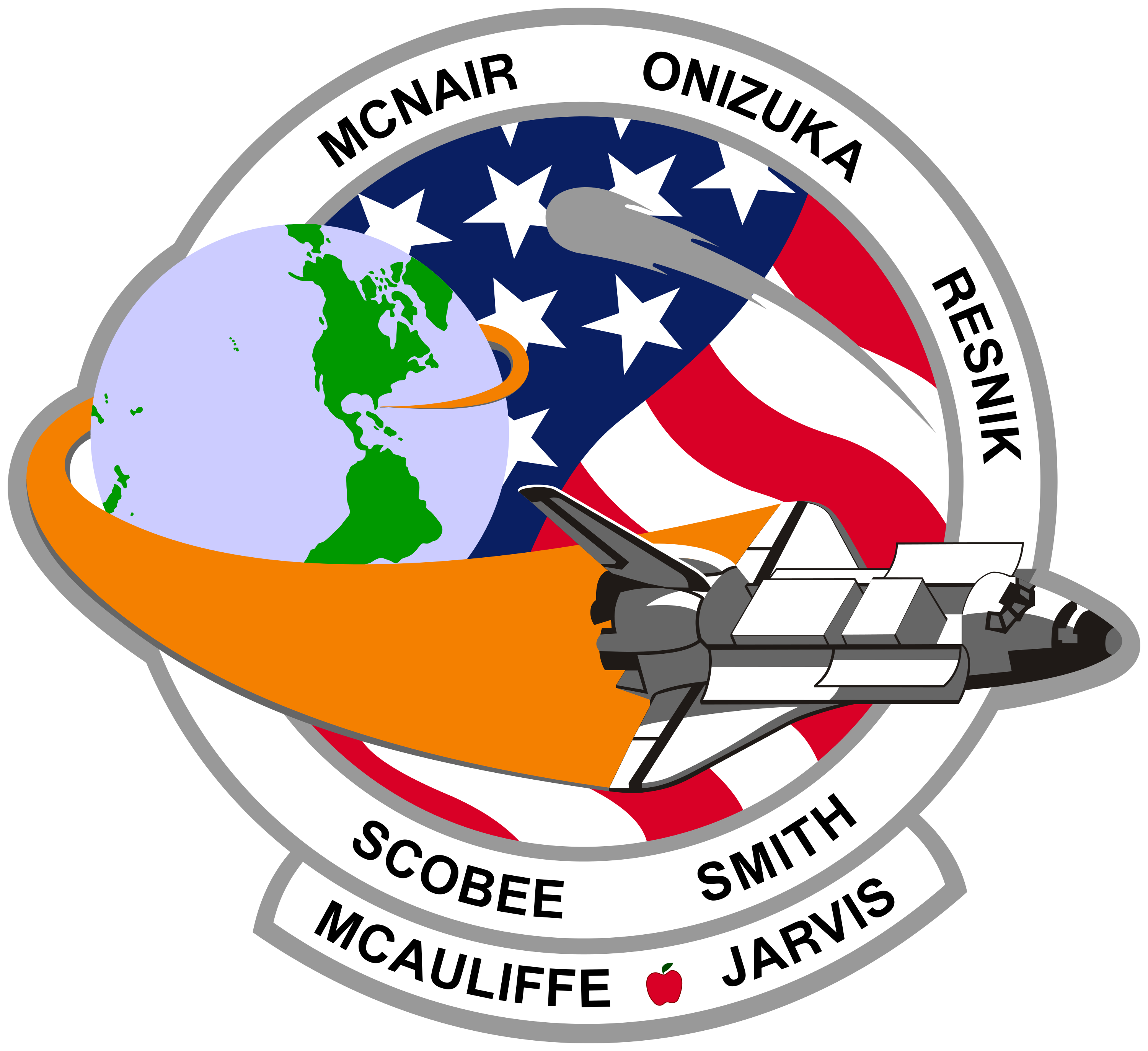 Gregory B. Jarvis - Sharon Christa McAuliffe - Ronald E. McNair - Ellison S. Onizuka
Judith A. Resnik - Francis R. Scobee - Michael J. Smith
STS-51L - January 28, 1986
Saturday, January 27, 2007
In Memoriam: 1/27/2007

Virgil I. "Gus" Grissom - Edward H. White II - Roger B. Chaffee
January 27, 1967
We Remember and Honor Their Sacrifice
Thursday, January 25, 2007
TFH 1/25: MER-B "Opportunity"
Ok, I know, I'm off by a day (darn Wikipedia using GMT to time/date everything!), but in any case the story of the successful landing, and subsequent much-better-than-anybody's-dreams performance, of NASA's two Mars Exploration Rovers is the subject of today's installment of TFH. MER-A, Spirit, successfully landed on Mars on January 3, 2004. Its sibling MER-B, Opportunity, landed on the red planet on January 24, 2004. Successfully landing on Mars is a big deal; many spacecraft - Mariner 3, Mariner 8, Mars Observer, Mars Climate Orbiter, and Mars Polar Lander just to name a few - have all been lost at some point on their journey. Building on the successful landing of Mars Pathfinder on July 4, 1997, engineers at NASA's Jet Propulsion Laboratory enhanced the Entry, Descent, and Landing (EDL) systems for use by the MERs. This amazing system of heatshield, parachute, retrorockets, and airbags safely delivered both Spirit and Opportunity to the Martian surface, where they are both still exploring three Earth years later! If you'd like to learn more about what it took to get Spirit and Opportunity to Mars, and how they're still roaming the surface today, check out the main website, but also look at the video clips on this page, particularly the ones for navigating to Mars, and "6 Minutes of Terror" - the story of Entry, Descent, and Landing. This story is even better because both MERs were only designed for a 90 sol (e.g. Martian Day) life span. Spirit will enter its 1,090th sol in the next day; Opportunity is at 978 sols. Getting to Mars safely is a huge achievement. The Mars Exploration Rovers are a national triumph. My congratulations go to all those who have worked on these amazing exploits! However, for navigation engineers Lou D'Amario and Darren Baird (seen in the "navigating" video) - and for EDL engineers Jaime Dyk, Wayne Lee, Rob Manning, Tom Rivellini, and Adam Steltzner (all appear in the "EDL" video) - along with all your other colleagues who were involved with getting the rovers down to the surface, the safe arrivals of Spirit on January 3, 2004 and Opportunity on January 24, 2004 were your finest hour!

The Final Frontier
Just added a bunch of links under "Sites on My Mind" to various NASA web sites. I've always been a "space nut", and strongly believe that space exploration is one of things that our government spends our tax dollars on that can't be funded enough. Check them out.
Later today, I'll be posting about a particular current space project as today's installment of "Their Finest Hour".
Later today, I'll be posting about a particular current space project as today's installment of "Their Finest Hour".
Tuesday, August 15, 2006
Space Exploration (Does CNN read this?)
My NASA rant yesterday appears to have been ahead of the curve, given this article today on CNN. Looks like at least some of the engineers building "Apollo 2" are paying attention to the past.
Monday, August 14, 2006
Space History & Future: does this come as a surprise?
This story from Reuters (a.k.a al-Reuters) pretty much sums up what went wrong with our Nation's space program - NASA actually can't find their original data materials (tapes, etc.) from the first moon landing. I mean, why would one want to hang on to them anyway? Seriously, it was only the most important human achievement of the 20th Century, if not ever.
Of course, this probably shouldn't be a surprise given NASA's "back to the future" program to replace the Space Shuttle looks a lot like the Apollo spacecraft (which, IMO we should still be flying the third or fourth generation of already, much in the same way the Russians still fly Soyuz derivatives) - one might think that somebody at NASA with tons invested in Space Shuttle development would make us want to think: "Hey, we've never done it this way before." I wonder if it's possible to have "Not Invented Here" syndrome in an organization that did invent it here, 40 YEARS AGO.
Fortunately, and as the article notes, NASA does have plenty from the Apollo era, and much of it can be accessed from the "history" section of their Human Spaceflight site. I find the lunar surface journals particularly interesting, and they include many, many multimedia clips from the glory days of men on the moon. My particular favorite is on the Apollo 11 site here - scroll down in the transcript and listen to the audio clip that follows the entry at 102:36:46. The recording has the air-to-ground loop on one channel and the mission control loop on the other. It brings chills to my spine, and a whole lot of National pride, to hear flight director Gene "Failure is not an Option" Kranz poll the controllers for a go/no-go on the landing, followed by CAPCOM astronaut Charlie Duke radio up at 102:42:08, "Eagle, Houston. You're GO for landing."
Speaking of which, if you've never seen the HBO mini-series, "From the Earth to the Moon", do so. It in its entirety should be required viewing in every high school U.S. history class.
"We choose to go to the moon...and do the other things, not because they are easy, but because they are hard, because that goal will serve to organize and measure the best of our energies and skills, because that challenge is one that we are willing to accept, one we are unwilling to postpone, and one which we intend to win."
--President John F. Kennedy, 9/12/1962, Rice University, Houston,
Texas
I hope we make it back there, before the Chicomms get there in the first place.
Of course, this probably shouldn't be a surprise given NASA's "back to the future" program to replace the Space Shuttle looks a lot like the Apollo spacecraft (which, IMO we should still be flying the third or fourth generation of already, much in the same way the Russians still fly Soyuz derivatives) - one might think that somebody at NASA with tons invested in Space Shuttle development would make us want to think: "Hey, we've never done it this way before." I wonder if it's possible to have "Not Invented Here" syndrome in an organization that did invent it here, 40 YEARS AGO.
Fortunately, and as the article notes, NASA does have plenty from the Apollo era, and much of it can be accessed from the "history" section of their Human Spaceflight site. I find the lunar surface journals particularly interesting, and they include many, many multimedia clips from the glory days of men on the moon. My particular favorite is on the Apollo 11 site here - scroll down in the transcript and listen to the audio clip that follows the entry at 102:36:46. The recording has the air-to-ground loop on one channel and the mission control loop on the other. It brings chills to my spine, and a whole lot of National pride, to hear flight director Gene "Failure is not an Option" Kranz poll the controllers for a go/no-go on the landing, followed by CAPCOM astronaut Charlie Duke radio up at 102:42:08, "Eagle, Houston. You're GO for landing."
Speaking of which, if you've never seen the HBO mini-series, "From the Earth to the Moon", do so. It in its entirety should be required viewing in every high school U.S. history class.
"We choose to go to the moon...and do the other things, not because they are easy, but because they are hard, because that goal will serve to organize and measure the best of our energies and skills, because that challenge is one that we are willing to accept, one we are unwilling to postpone, and one which we intend to win."
--President John F. Kennedy, 9/12/1962, Rice University, Houston,
Texas
I hope we make it back there, before the Chicomms get there in the first place.
Subscribe to:
Posts (Atom)