From the Manhattan Institute and the wonderful Andrew Klavan:
ATTENTION:

Tuesday, October 18, 2011


TFH 10/18: Sergeant Max Thompson, USA
As the Allied Expeditionary Force pressed into Nazi Germany in the fall of 1944, the armies of liberty met fierce resistance. On October 17th, one brave American refused to yield to an enemy counterattack on vital high ground.
From Medal of Honor Citations for World War II:
From Medal of Honor Citations for World War II:
THOMPSON, MAX
Rank and organization: Sergeant, U.S. Army, Company
K, 18th Infantry, 1st Infantry Division. Place and date: Near Haaren, Germany,
18 October 1944. Entered service at: Prescott, Ariz. Birth: Bethel, N.C. G.O.
No.: 47, 18 June 1945. Citation: On 18 October 1944, Company K, 18th Infantry,
occupying a position on a hill near Haaren, Germany, was attacked by an enemy
infantry battalion supported by tanks. The assault was preceded by an artillery
concentration, lasting an hour, which inflicted heavy casualties on the company.
While engaged in moving wounded men to cover, Sgt. Thompson observed that the
enemy had overrun the positions of the 3d Platoon. He immediately attempted to
stem the enemy's advance single-handedly. He manned an abandoned machine gun and
fired on the enemy until a direct hit from a hostile tank destroyed the gun.
Shaken and dazed, Sgt. Thompson picked up an automatic rifle and although alone
against the enemy force which was pouring into the gap in our lines, he fired
burst after burst, halting the leading elements of the attack and dispersing
those following. Throwing aside his automatic rifle, which had jammed, he took
up a rocket gun, fired on a light tank, setting it on fire. By evening the enemy
had been driven from the greater part of the captured position but still held 3
pillboxes. Sgt. Thompson's squad was assigned the task of dislodging the enemy
from these emplacements. Darkness having fallen and finding that fire of his
squad was ineffective from a distance, Sgt. Thompson crawled forward alone to
within 20 yards of 1 of the pillboxes and fired grenades into it. The Germans
holding the emplacement concentrated their fire upon him. Though wounded, he
held his position fearlessly, continued his grenade fire, and finally forced the
enemy to abandon the blockhouse. Sgt. Thompson's courageous leadership inspired
his men and materially contributed to the clearing of the enemy from his last
remaining hold on this important hill position.
Max Thompson survived the war and passed away at age 74 of November 30, 1996. He rests in Forest Lawn Cemetery, Enka, NC.
Monday, October 17, 2011
TFH 10/17: Major Gregory Boyington, USMCR
Gregory Boyington was born on December 12, 1912 in Coeur d'Alene, ID. In 1930 he began studies at the University of Washington, graduating in 1934 with a degree in aeronautical engineering and went to work for Boeing. His military service began through ROTC while in college. In 1936, he volunteered for the United States Marine Corps aviation cadet program, received a commission, and served until August of 1941.
Boyington's service to the battle against tyranny began before the USA's entry into World War II. His resignation from the Marine Corps was so that he could join the American Volunteer Group, also known as the "Flying Tigers". He flew many missions in Curtiss P-40 Warhawk fighters, and was credited with at least 3.5 kills of Japanese aircraft over mainland China.
Upon returning to the United States in 1942, he reentered the Marine Corps and was assigned with the rank of Major to VMF-121 at Guadalcanal. He was then posted as the commander of VMF-214, the "Black Sheep" squadron flying the Vought F4U Corsair.
From September 1943 to January 1944 as the VMF-214 commander, he was credited with shooting down 26 enemy aircraft. His leadership and skill in combat earned him our Nation's second-highest honor, the Navy Cross.
On October 17, 1943 he led a mission against Kahili in the Solomon Islands that contributed to his recognition with our Nation's highest honor. From Medal of Honor Citations for World War II:
Saturday, October 15, 2011
TFH 10/15: Sergeant First Class Webster Anderson, USA
Artillerymen don't usually act as infantrymen. Sometimes when they do, they do so with incredible valor as one brave gunner of the 101st Airborne Division did this day in 1967.
From Medal of Honor Citations for the Vietnam War:
From Medal of Honor Citations for the Vietnam War:
ANDERSON, WEBSTER
Rank and organization: Sergeant First Class, U.S.
Army, Battery A, 2d Battalion, 320th Field Artillery, 101st Airborne Infantry
Division (Airmobile). Place and date: Tam Ky, Republic of Vietnam, 15 October
1967. Entered service at: Winnsboro, S.C. Born: 15 July 1933, Winnsboro, S.C.
Citation: Sfc. Anderson (then S/Sgt.), distinguished himself by conspicuous
gallantry and intrepidity in action while serving as chief of section in Battery
A, against a hostile force. During the early morning hours Battery A's defensive
position was attacked by a determined North Vietnamese Army infantry unit
supported by heavy mortar, recoilless rifle, rocket propelled grenade and
automatic weapon fire. The initial enemy onslaught breached the battery
defensive perimeter. Sfc. Anderson, with complete disregard for his personal
safety, mounted the exposed parapet of his howitzer position and became the
mainstay of the defense of the battery position. Sfc. Anderson directed
devastating direct howitzer fire on the assaulting enemy while providing rifle
and grenade defensive fire against enemy soldiers attempting to overrun his gun
section position. While protecting his crew and directing their fire against the
enemy from his exposed position, 2 enemy grenades exploded at his feet knocking
him down and severely wounding him in the legs. Despite the excruciating pain
and though not able to stand, Sfc. Anderson valorously propped himself on the
parapet and continued to direct howitzer fire upon the closing enemy and to
encourage his men to fight on. Seeing an enemy grenade land within the gun pit
near a wounded member of his gun crew, Sfc. Anderson heedless of his own safety,
seized the grenade and attempted to throw it over the parapet to save his men.
As the grenade was thrown from the position it exploded and Sfc. Anderson was
again grievously wounded. Although only partially conscious and severely
wounded, Sfc. Anderson refused medical evacuation and continued to encourage his
men in the defense of the position. Sfc. Anderson by his inspirational
leadership, professionalism, devotion to duty and complete disregard for his
welfare was able to maintain the defense of his section position and to defeat a
determined attack. Sfc. Anderson's gallantry and extraordinary heroism at the
risk of his life above and beyond the call of duty are in the highest traditions
of the military service and reflect great credit upon himself, his unit, and the
U.S. Army.
Webster Anderson survived, but lost both his legs and part of one arm. He passed away in 2003 at age 70 and rests in the cemetery of Blackjack Baptist Church in his home town of Winnsboro, SC.
Never forget that we are the land of the free because of the brave!
Marxist Irony, iTunes Edition
On my iPhone, I have five apps that I use quite regularly (two more than the other three). They were free, and are e-readers with the texts of:
Thomas Paine's Common Sense
The Declaration of Independence
The Federalist Papers
The Constitution of the United States
Adam Smith's An Inquiry into the Nature and Causes of the Wealth of Nations
All free! Even the capitalist bible of The Wealth of Nations!!!!
So, it occurs to me that it might be nice to be able to have the opposition's text(s) too, so I just searched on the iTunes AppStore for The Communist Manifesto (Marx/Engels) and Das Kapital (Marx). Care to guess what I found?
Yep. There are no free apps with the texts of those two. Funny that someone wants to make money off of Marxism, considering that the works - all that I've listed - are in the public domain.
Thomas Paine's Common Sense
The Declaration of Independence
The Federalist Papers
The Constitution of the United States
Adam Smith's An Inquiry into the Nature and Causes of the Wealth of Nations
All free! Even the capitalist bible of The Wealth of Nations!!!!
So, it occurs to me that it might be nice to be able to have the opposition's text(s) too, so I just searched on the iTunes AppStore for The Communist Manifesto (Marx/Engels) and Das Kapital (Marx). Care to guess what I found?
Yep. There are no free apps with the texts of those two. Funny that someone wants to make money off of Marxism, considering that the works - all that I've listed - are in the public domain.
Friday, October 14, 2011
TFH 10/14: Three Heroes in the Waning Days of WWI
On October 14, 1918, three brave Americans - one Soldier, two Marines - showed the best the United States can offer in the face of tyranny and received our Nation's highest honor.
From Medal of Honor Citations for World War I:
From Medal of Honor Citations for World War I:
DONALDSON, MICHAEL A.
Rank and organization: Sergeant, U.S. Army, Company
I, 165th Infantry, 42d Division. Place and date: At Sommerance-Landres-et St.
Georges Road, France, 14 October 1918. Entered service at: Haverstraw, N.Y.
Born: 1884, Haverstraw, N.Y. G.O. No.: 9, W.D., 1923. Citation: The advance of
his regiment having been checked by intense machinegun fire of the enemy, who
were entrenched on the crest of a hill before Landres-et St. Georges, his
company retired to a sunken road to reorganize their position, leaving several
of their number wounded near the enemy lines. Of his own volition, in broad
daylight and under direct observation of the enemy and with utter disregard for
his own safety, he advanced to the crest of the hill, rescued one of his wounded
comrades, and returned under withering fire to his own lines, repeating his
splendidly heroic act until he had brought in all the men, 6 in number.
ROBINSON, ROBERT GUY
Rank and organization: Gunnery Sergeant, U.S. Marine
Corps, 1st Marine Aviation Force Place and date: Pittham, Belgium, 14 October
1918. Entered service at: Chicago, Ill. Born: 30 April 1896, New York, N.Y.
Citation: For extraordinary heroism as observer in the 1st Marine Aviation Force
at the front in France. In company with planes from Squadron 218, Royal Air
Force, conducting an air raid on 8 October 1918, G/Sgt. Robinson's plane was
attacked by 9 enemy scouts. In the fight which followed, he shot down 1 of the
enemy planes. In a later air raid over Pittham, Belgium, on 14 October 1918, his
plane and 1 other became separated from their formation on account of motor
trouble and were attacked by 12 enemy scouts. Acting with conspicuous gallantry
and intrepidity in the fight which ensued, G/Sgt. Robinson, after shooting down
1 of the enemy planes, was struck by a bullet which carried away most of his
elbow. At the same time his gun jammed. While his pilot maneuvered for position,
he cleared the jam with one hand and returned to the fight. Although his left
arm was useless, he fought off the enemy scouts until he collapsed after
receiving 2 more bullet wounds, one in the stomach and one in the thigh.
*TALBOT, RALPH
Rank and organization: Second Lieutenant, U.S. Marine
Corps. Born: 6 January 1897, South Weymouth, Mass. Appointed from: Connecticut.
Citation: For exceptionally meritorious service and extraordinary heroism while
attached to Squadron C, 1st Marine Aviation Force, in France. 2d Lt. Talbot
participated in numerous air raids into enemy territory. On 8 October 1918,
while on such a raid, he was attacked by 9 enemy scouts, and in the fight that
followed shot down an enemy plane. Also, on 14 October 1918, while on a raid
over Pittham, Belgium, 2d Lt. Talbot and another plane became detached from the
formation on account of motor trouble and were attacked by 12 enemy scouts.
During the severe fight that followed, his plane shot down 1 of the enemy
scouts. His observer was shot through the elbow and his gun jammed. 2d Lt.
Talbot maneuvered to gain time for his observer to clear the jam with one hand,
and then returned to the fight. The observer fought until shot twice, once in
the stomach and once in the hip and then collapsed, 2d Lt. Talbot attacked the
nearest enemy scout with his front guns and shot him down. With his observer
unconscious and his motor failing, he dived to escape the balance of the enemy
and crossed the German trenches at an altitude of 50 feet, landing at the
nearest hospital to leave his observer, and then returning to his aerodrome.
Second Lieutenant Talbot lost his life in service to our nation eleven days later when his Airco/de Havilland DH-4 biplane crashed on a test flight. His namesake, the USS Ralph Talbot (DD-390), served throughout World War II - surviving the attack on Pearl Harbor and earning 14 battle stars. Gunnery Sergant Robinson survived the war and passed away at age 78 in 1974; he rests in Arlington National Cemetery. Sergeant Donaldson also survived the war and died at age 86 in 1970; he rests in St. Peter's Cemetery in his home town of Haverstraw, NY.
How Not to Run for President
Who do I support for President? I'm firmly in the "Not Romney" crowd. I passionately want to vote for a candidate. I'm sick and tired of picking the "least worst". With each passing day though, the forces are aligning to anoint Mitt Romney the GOP standard bearer. If that's what happens, my vote in the Pennsylvania primary will be meaningless and I'll have the same enthusiasm to vote for Romney in 2012 that I had for McCain in 2008 - which is to say, none.
I'll admit to being a fan of what I'll term the "fictitious" Rick Perry, that is, the Rick Perry prior to announcing his Presidential run and his mind-boggingly poor debate performances. The campaign produced a fantastic video which would be even better if the candidate acted as confident and as tenacious as he's portrayed 24-by-7.
I love this video, and yes, it makes me yearn for a candidate - perhaps Governor Perry - who is not afraid to attack President Obama, Mitt Romney, and the entire Republican establishment with every waking moment, breath, and sound out of their mouth.
I don't claim to be an expert on Presidential campaigns, but I do consider myself at least versed in common sense. Governor Perry's campaign thus far has shown none. Had I been running Governor Perry's campaign, here's what I would have done differently.
I don't claim to be an expert on Presidential campaigns, but I do consider myself at least versed in common sense. Governor Perry's campaign thus far has shown none. Had I been running Governor Perry's campaign, here's what I would have done differently.
Thursday, October 13, 2011
Happy Birthday to the Iron Lady!
Today is Margaret Thatcher's (Officially The Right Honorable The Baroness Thatcher LG OM PC FRS) 86th Birthday!
Which means, it's a good day to surf around on the Margaret Thatcher Foundation's web site!
Margaret Thatcher is one of the icons of Liberty from the latter half of the 20th Century and we have much to thank her for with her contributions to the freedom of man.
Which means, it's a good day to surf around on the Margaret Thatcher Foundation's web site!
Margaret Thatcher is one of the icons of Liberty from the latter half of the 20th Century and we have much to thank her for with her contributions to the freedom of man.
Happy 236th Birthday, United States Navy!
Since October 13, 1775 - Non sibi sed patriae (Not self but country)...
Thanks to all the Sailors past, present, and future, and may He protect those in peril on the sea.
Thanks to all the Sailors past, present, and future, and may He protect those in peril on the sea.
TFH 10/13: Captain James M. Burt, USA
As the Allied Expeditionary Force pressed in to Germany in 1944, one brave American tank company commander's courage gained an important victory, and was recognized with our Nation's highest honor.
From Medal of Honor Citations from World War II:
From Medal of Honor Citations from World War II:
BURT, JAMES M.
Rank and organization: Captain, U.S. Army, Company B,
66th Armored Regiment, 2d Armored Division. Place and date: Near Wurselen,
Germany, 13 October 1944. Entered service at: Lee, Mass. Birth: Hinsdale, Mass.
G.O. No.: 95, 30 October 1945. Citation: Capt. James M. Burt was in command of
Company B, 66th Armored Regiment on the western outskirts of Wurselen, Germany,
on 13 October 1944, when his organization participated in a coordinated
infantry-tank attack destined to isolate the large German garrison which was
tenaciously defending the city of Aachen. In the first day's action, when
infantrymen ran into murderous small-arms and mortar fire, Capt. Burt dismounted
from his tank about 200 yards to the rear and moved forward on foot beyond the
infantry positions, where, as the enemy concentrated a tremendous volume of fire
upon him, he calmly motioned his tanks into good firing positions. As our attack
gained momentum, he climbed aboard his tank and directed the action from the
rear deck, exposed to hostile volleys which finally wounded him painfully in the
face and neck. He maintained his dangerous post despite pointblank
self-propelled gunfire until friendly artillery knocked out these enemy weapons,
and then proceeded to the advanced infantry scouts' positions to deploy his
tanks for the defense of the gains which had been made. The next day, when the
enemy counterattacked, he left cover and went 75 yards through heavy fire to
assist the infantry battalion commander who was seriously wounded. For the next
8 days, through rainy, miserable weather and under constant, heavy shelling,
Capt. Burt held the combined forces together, dominating and controlling the
critical situation through the sheer force of his heroic example. To direct
artillery fire, on 15 October, he took his tank 300 yards into the enemy lines,
where he dismounted and remained for 1 hour giving accurate data to friendly
gunners. Twice more that day he went into enemy territory under deadly fire on
reconnaissance. In succeeding days he never faltered in his determination to
defeat the strong German forces opposing him. Twice the tank in which he was
riding was knocked out by enemy action, and each time he climbed aboard another
vehicle and continued the fight. He took great risks to rescue wounded comrades
and inflicted prodigious destruction on enemy personnel and materiel even though
suffering from the wounds he received in the battle's opening phase. Capt.
Burt's intrepidity and disregard of personal safety were so complete that his
own men and the infantry who attached themselves to him were inspired to
overcome the wretched and extremely hazardous conditions which accompanied one
of the most bitter local actions of the war. The victory achieved closed the
Aachen gap.
Today, the 3rd Battalion of the 66th Armored Regiment is nicknamed "Burt's Knights". 3-66 Armor deployed to Iraq in 2008-2009. James Burt returned to civilian life after the war and passed away at age 88 on February 15, 2006.
The motto of the 66th Armor Regiment is "Sempre in Hostes" - "Always into the Enemy". We salute all the brave men and women of our armed forces - on this day, the tankers in particular. So long as our forces are "always into the enemy", liberty will be victorious.
Wednesday, October 12, 2011
Ten Years is too Long for Victory
Last Friday (October 7) marked 10 years of the War on Terror and Operation Enduring Freedom - our attack on Al Qaeda. Ten years. I have a problem with the United States waging war for ten years without victory.
First, let me state unequivocally that I support the war and the brave men and women fighting it. I believe categorically that it is impossible to "support the troops" without supporting the mission they are on. I want the United States to achieve victory - however long it takes.
I mourn the loss of the 1,754 servicemen who have given their lives in Afghanistan, honor the sacrifice made by the over 14,000 wounded, and applaud all of those who have served with honor. Our Nation owes you a great debt.
That said, I am appalled that we are still fighting there in 2011 after 10 years. Fighting 10 years after the first shot indicates to me just one thing: we do not have the political and social will to achieve victory.
How do I define victory in this, or any war? Once the President, with concurrence of Congress (as happened in both cases of Afghanistan and Iraq), commits our Armed Forces to war there should be only two possible outcomes for the enemy: unconditional surrender or complete destruction.
I question if the United States actually has the ability to wage war anymore. Before anybody throws a gasket, I am not questioning the dedication or professionalism of our military. Far from. I am questioning the character of our society that thinks that war can be waged in a "nice" way. Our Nation would be much better off had the term "collateral damage" never crept into the lexicon.
We should have destroyed our enemy in Afghanistan ten times over by now. I believe that unrealistic expectations and militarily unjustifiable restrictions placed on our forces prevent us from destroying our enemies, or bringing them to their knees in surrender, are the reason we are still fighting after 10 years.
Why has the United States "gone soft" when it comes to waging war and achieving victory? I'll be exploring this from time to time in this space, the first segment of which will appear shortly and is called "The PGM Effect".
God bless all of our Soldiers, Sailors, Airmen, Marines, and Coast Guardsmen, and may His grace shield you through every battle and take you from victory to victory.
First, let me state unequivocally that I support the war and the brave men and women fighting it. I believe categorically that it is impossible to "support the troops" without supporting the mission they are on. I want the United States to achieve victory - however long it takes.
I mourn the loss of the 1,754 servicemen who have given their lives in Afghanistan, honor the sacrifice made by the over 14,000 wounded, and applaud all of those who have served with honor. Our Nation owes you a great debt.
That said, I am appalled that we are still fighting there in 2011 after 10 years. Fighting 10 years after the first shot indicates to me just one thing: we do not have the political and social will to achieve victory.
How do I define victory in this, or any war? Once the President, with concurrence of Congress (as happened in both cases of Afghanistan and Iraq), commits our Armed Forces to war there should be only two possible outcomes for the enemy: unconditional surrender or complete destruction.
I question if the United States actually has the ability to wage war anymore. Before anybody throws a gasket, I am not questioning the dedication or professionalism of our military. Far from. I am questioning the character of our society that thinks that war can be waged in a "nice" way. Our Nation would be much better off had the term "collateral damage" never crept into the lexicon.
We should have destroyed our enemy in Afghanistan ten times over by now. I believe that unrealistic expectations and militarily unjustifiable restrictions placed on our forces prevent us from destroying our enemies, or bringing them to their knees in surrender, are the reason we are still fighting after 10 years.
Why has the United States "gone soft" when it comes to waging war and achieving victory? I'll be exploring this from time to time in this space, the first segment of which will appear shortly and is called "The PGM Effect".
God bless all of our Soldiers, Sailors, Airmen, Marines, and Coast Guardsmen, and may His grace shield you through every battle and take you from victory to victory.
TFH 10/12: Lieutenant Commander George Thomas Coker, USNR
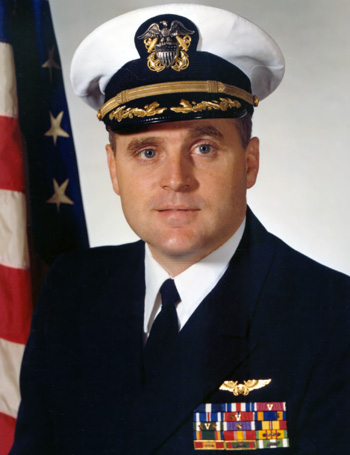
(Photo: Wikimedia)
George Thomas Coker was born in Amarillo, TX on July 14, 1943. His family moved to Linden, NJ in 1951. He attended St. Benedict's Preparatory School in Newark and became an Eagle Scout on January 27, 1959. While studying at Rutgers University from 1961-1963, he entered the Navy's aviation officer cadet program, received a commission, and became a Naval Flight Officer. George Coker eventually graduated from the University of San Diego in 1976; his studies were interrupted by his gallant service to our Nation during the Vietnam War.
In 1966, Coker deployed with Navy Attack Squadron VA-65 on board the USS Constellation. VA-65 flew the A-6 Intruder, and then Lieutenant Coker was a bombardier/navigator. He recieved two Navy Commendation Medals and the Distinguished Flying Cross for "resourcefulness, superb airmanship, and courage" throughout 54 air missions over enemy territory.
George Coker's 55th mission on August 27, 1966 changed the course of this great American's life. On that day, his A-6 was shot down by a surface-to-air missile over North Vietnam. Both Coker and the A-6's pilot, John H. "Jack" Fellowes, were captured.
After his capture, Coker's fighting spirit and devotion to our Nation could not be broken. He resisted his incarceration as best as possible while working to maintain morale among his comrades.
On October 12, 1967 Coker and another prisoner, Captain George McKnight (USAF), escaped from Dirty Bird Prison. For his courage and refusal to be held captive, he was awarded our Nation's second-highest honor: the Navy Cross.
Tuesday, October 11, 2011
The Real Jason Altmire
Rep. Jason Altmire (D-PA-04) is my representative and is considered a "Blue Dog" or "moderate" Democrat. President Obama is in Pittsburgh today to preach his New Soviet Man Five-Year Plan. Mr. Altmire was there to gleefully welcome the President at the airport (pic linked from the Pittsburgh Post-Gazette):


Mr. Altmire is third from the left. Remember that grin when he tries to run against much of Obama's agenda as a "moderate" next year.
TFH 10/11: Colonel Neel E. Kearby, USAAC
Twelve-to-one odds. Six kills, indomitable courage and leadership in the skies!
From Medal of Honor Citations for World War II:
From Medal of Honor Citations for World War II:
KEARBY, NEEL E. (Air Mission)
Rank and organization: Colonel, U.S. Army Air Corps.
Place and date: Near Wewak, New Guinea, 11 October 1943. Entered service at:
Dallas, Tex. Birth: Wichita Falls, Tex. G.O. No.: 3, 6 January 1944. Citation:
For conspicuous gallantry and intrepidity above and beyond the call of duty in
action with the enemy, Col. Kearby volunteered to lead a flight of 4 fighters to
reconnoiter the strongly defended enemy base at Wewak. Having observed enemy
installations and reinforcements at 4 airfields, and secured important tactical
information, he saw an enemy fighter below him, made a diving attack and shot it
down in flames. The small formation then sighted approximately 12 enemy bombers
accompanied by 36 fighters. Although his mission had been completed, his fuel
was running low, and the numerical odds were 12 to 1, he gave the signal to
attack. Diving into the midst of the enemy airplanes he shot down 3 in quick
succession. Observing 1 of his comrades with 2 enemy fighters in pursuit, he
destroyed both enemy aircraft. The enemy broke off in large numbers to make a
multiple attack on his airplane but despite his peril he made one more pass
before seeking cloud protection. Coming into the clear, he called his flight
together and led them to a friendly base. Col. Kearby brought down 6 enemy
aircraft in this action, undertaken with superb daring after his mission was
completed.
Colonel Kearby was the commander of the 348th Fighter Group, flying the P-47 Thunderbolt. By March, 1944 he personally was credited with the destruction of 22 enemy aircraft. Sadly, Colonel Kearby was shot down on March 5, 1944 later in the New Guinea campaign and died of his wounds. He rests in Sparkman Hillcrest Memorial Park in Dallas, TX.
We are forever grateful to our brave airmen, and for Neel E. Kearby's finest hour in service to our Nation on October 11, 1943.
Science and Religion - Not Mutually Exclusive
I was very pleased to read the article from the Los Angeles Times "Science and religion: A false divide" by Dr. John H. Evans, sociology professor at UC San Diego. (Hat Tip: Hot Air)
I am an evangelical Christian. I believe that the Bible is true, but that it is also crucial to delineate in the text between what is taken as literal, word-for-word truth or fact and what is to be taken as allegory or apocalyptic text and literature, that is, "truth" that speaks to the nature of God but not to actual events. Such a delineation does not detract from the whole truth of the Biblical story, which after all is about God, not man.
It drives me nuts to hear Christians quibble over non-salvific points such as "creation happened in a literal six days" when whether or not it is literal time or allegory is 100% irrelevant to the Biblical truth of John 14:6.
I also believe in science, and do not view what I have learned from science and what I believe through faith to be mutually exclusive.
Example: I hold that the Big Bang Theory is supported by observation and experimentation and that it is describing in scientific terms the same beginning of creation as found in Genesis 1:1-5.
I also hold that a belief in creation does not preclude a belief in evolution, for "with God all things are possible." (Matthew 19:26b) Who are we to say that God can not have established and uses evolution? If one believes that God is omnipotent, then one must logically concede that if God wants to have species evolve He can most certainly do that.
Do I believe evolution is a fact? Yes. The fossil record, dinosaurs-into-birds, etc. are enough evidence for me. Do I believe that evolution is used by God and evolutionary processes are part of God's creation? Yes. Do I believe that evolution can explain the genesis of life and the rise of the human race? No.
Do I believe that science will one day be able to synthesize life by laboratory chemistry? No. While I don't believe it will happen, an intellectually honest, pure evolutionist who does would have to admit that the belief in "evolution explains all" is rooted in faith, not science. In that, science and religion are identical. To sum up, I'll quote Dr. Evans' writing:
I am an evangelical Christian. I believe that the Bible is true, but that it is also crucial to delineate in the text between what is taken as literal, word-for-word truth or fact and what is to be taken as allegory or apocalyptic text and literature, that is, "truth" that speaks to the nature of God but not to actual events. Such a delineation does not detract from the whole truth of the Biblical story, which after all is about God, not man.
It drives me nuts to hear Christians quibble over non-salvific points such as "creation happened in a literal six days" when whether or not it is literal time or allegory is 100% irrelevant to the Biblical truth of John 14:6.
I also believe in science, and do not view what I have learned from science and what I believe through faith to be mutually exclusive.
Example: I hold that the Big Bang Theory is supported by observation and experimentation and that it is describing in scientific terms the same beginning of creation as found in Genesis 1:1-5.
I also hold that a belief in creation does not preclude a belief in evolution, for "with God all things are possible." (Matthew 19:26b) Who are we to say that God can not have established and uses evolution? If one believes that God is omnipotent, then one must logically concede that if God wants to have species evolve He can most certainly do that.
Do I believe evolution is a fact? Yes. The fossil record, dinosaurs-into-birds, etc. are enough evidence for me. Do I believe that evolution is used by God and evolutionary processes are part of God's creation? Yes. Do I believe that evolution can explain the genesis of life and the rise of the human race? No.
Do I believe that science will one day be able to synthesize life by laboratory chemistry? No. While I don't believe it will happen, an intellectually honest, pure evolutionist who does would have to admit that the belief in "evolution explains all" is rooted in faith, not science. In that, science and religion are identical. To sum up, I'll quote Dr. Evans' writing:
The greatest conflict between fundamentalists, evangelicals and science is not over facts but over values. While scientists like to say that their work is value-free, that is not how the public views it, and conservative Protestants especially have homed in on the moral message of science....
To move forward, we, as a country, need to lower the political conflict. Yes, the views found in fundamentalist churches are not exactly the same as those at the National Science Foundation. But we would see less of the polarizing "we real Americans" rhetoric from the religious right if its members were not ridiculed as know-nothings. Conservative Protestants are not fundamentally opposed to all science.Hear, hear!
Friday, October 07, 2011
"Settled" Science
Last night via Twitter, I was alerted to today's Washington Post column by Charles Krauthammer, "Gone in 60 nanoseconds".
Mr. Krauthammer calls to attention a surely under-reported story: "Scientists at CERN, the European high-energy physics consortium, have announced the discovery of a particle that can travel faster than light." (Italics in original)
What? Now, I have to say that I'm skeptical about the claim - as are most theoretical physicists. Experimentation validating Einstein's theory of relativity are numerous and easily understandable, but could it really be that Einstein was wrong about the speed of light being an absolute maximum?
Of course it could be. Scientific advances are often produced by completely unexpected observations and evidence. I really think this is a big deal, for as Mr. Krauthammer points out:
Now, if true, does this change everything? Well...no, not really. Newtonian physics aren't invalid, they just can't explain everything. Einstein's theories are just that - theories. Do they explain a lot? Yes, as experimentation has verified. Do they explain everything? Hardly.
Mr. Krauthammer calls to attention a surely under-reported story: "Scientists at CERN, the European high-energy physics consortium, have announced the discovery of a particle that can travel faster than light." (Italics in original)
What? Now, I have to say that I'm skeptical about the claim - as are most theoretical physicists. Experimentation validating Einstein's theory of relativity are numerous and easily understandable, but could it really be that Einstein was wrong about the speed of light being an absolute maximum?
Of course it could be. Scientific advances are often produced by completely unexpected observations and evidence. I really think this is a big deal, for as Mr. Krauthammer points out:
It cannot be. Yet, this is not a couple of guys in a garage peddling cold fusion. This is no crank wheeling a perpetual motion machine into the patent office. These are the best researchers in the world using the finest measuring instruments, having subjected their data to the highest levels of scrutiny, including six months of cross-checking by 160 scientists from 11 countries.Many other researchers are attempting to duplicate CERN's experiment to either confirm or invalidate the astonishing result.
Now, if true, does this change everything? Well...no, not really. Newtonian physics aren't invalid, they just can't explain everything. Einstein's theories are just that - theories. Do they explain a lot? Yes, as experimentation has verified. Do they explain everything? Hardly.
TFH 10/7: PFC John L. Barkley, USA
One brave American, a captured machine gun, and a disabled tank...
From Medal of Honor Citations for World War I:
From Medal of Honor Citations for World War I:
BARKLEY, JOHN L.
Rank and organization: Private First Class, U.S.
Army, Company K, 4th Infantry, 3d Division. Place and date: Near Cunel, France,
7 October 1918. Entered service at: Blairstown, Mo. Born: 28 August 1895
Blairstown, Mo. G.O. No.: 44, W.D., 1919. Citation: Pfc. Barkley, who was
stationed in an observation post half a kilometer from the German line, on his
own initiative repaired a captured enemy machinegun and mounted it in a disabled
French tank near his post. Shortly afterward, when the enemy launched a
counterattack against our forces, Pfc. Barkley got into the tank, waited under
the hostile barrage until the enemy line was abreast of him and then opened
fire, completely breaking up the counterattack and killing and wounding a large
number of the enemy. Five minutes later an enemy 77-millimeter gun opened fire
on the tank pointblank. One shell struck the drive wheel of the tank, but this
soldier nevertheless remained in the tank and after the barrage ceased broke up
a second enemy counterattack, thereby enabling our forces to gain and hold Hill
25.
We thank all our brave fighting men and women for their service to liberty, past, present, and future.
Wednesday, October 05, 2011
TFH 10/5: Private First Class Richard Edward Kraus, USMCR
From Medal of Honor Citations for World War II:
*KRAUS, RICHARD EDWARD
Rank and organization: Private First Class, U.S.
Marine Corps Reserve. Born: 24 November 1925, Chicago, Ill. Accredited to:
Minnesota. Citation: For conspicuous gallantry and intrepidity at the risk of
his life above and beyond the call of duty while serving with the 8th Amphibious
Tractor Battalion, Fleet Marine Force, in action against enemy Japanese forces
on Peleliu, Palau Islands, on 5 October 1944. Unhesitatingly volunteering for
the extremely hazardous mission of evacuating a wounded comrade from the front
lines, Pfc. Kraus and 3 companions courageously made their way forward and
successfully penetrated the lines for some distance before the enemy opened with
an intense, devastating barrage of hand grenades which forced the stretcher
party to take cover and subsequently abandon the mission. While returning to the
rear, they observed 2 men approaching who appeared to be marines and immediately
demanded the password. When, instead of answering, 1 of the 2 Japanese threw a
hand grenade into the midst of the group, Pfc. Kraus heroically flung himself
upon the grenade and, covering it with his body, absorbed the full impact of the
explosion and was instantly killed. By his prompt action and great personal
valor in the face of almost certain death, he saved the lives of his 3
companions, and his loyal spirit of self-sacrifice reflects the highest credit
upon himself and the U.S. Naval Service. He gallantly gave his life for his
comrades.
Richard Kraus, all of us who cherish liberty salute and honor your courage and sacrifice for the freedom of man. October 5, 1944 was your finest hour!
Monday, October 03, 2011
TFH 10/3: The Shot Heard 'Round the World
Sixty years ago today, Bobby Thomson hit one of the most famous walk-off home runs in baseball history.
Russ Hodges' home run call ranks up there with Al Michael's "Do you believe in miracles? YES!" The Giants beat the hated cross-town Brooklyn Dodgers and won the right to face the other cross-town team (actually, just across the Harlem River), the Yankees, in the 1951 World Series.
Russ Hodges' home run call ranks up there with Al Michael's "Do you believe in miracles? YES!" The Giants beat the hated cross-town Brooklyn Dodgers and won the right to face the other cross-town team (actually, just across the Harlem River), the Yankees, in the 1951 World Series.
The Yankees would go on to defeat the Giants in six games, the third of their five straight Series wins from 1949-1953.
(And my apologies for the late post!)
(And my apologies for the late post!)
Saturday, October 01, 2011
TFH 10/1: The Most Magical Place on Earth Turns 40
Walt Disney changed entertainment and is an enduring influence on our culture. Forty years ago today on October 1, 1971 the gates opened to Walt Disney World. Sadly, Walt did not live to see Disney World built, but we are grateful for his energy, his talent, and his imagination. We're all better for it!
My family and I were blessed to spend a week at WDW this summer, and can't wait to go back!


It all started with a mouse! Thanks Walt! (Pictures are my own).
My family and I were blessed to spend a week at WDW this summer, and can't wait to go back!


It all started with a mouse! Thanks Walt! (Pictures are my own).
Subscribe to:
Posts (Atom)